
Lushootseed Creation Histories
Land. Language. Lineage.
Feb. 7 through July, 31, 2026
Tidelands, Seattle
Creation Histories: Lushootseed Stories as Living Knowledge

In this clip from All My Relations, host Matika Wilbur (Swinomish & Tulalip) invites us into the living world of Coast Salish creation histories—stories that shape relationships between people, animals, and land. Through conversations with Puyallup Tribal Language Director Amber Hayward and Assistant Curator Ashley Frantz, we learn how Lushootseed creation histories have been preserved, disrupted, and revitalized through language, art, and community collaboration. Grounded in the teachings to “make yourself still and engage your five teachers,” this episode offers a powerful entry point into the exhibition Coast Salish Creation Stories and the deeper knowledge it carries.
Listen to the full episode everywhere you stream your podcasts
Lushootseed Creation Histories honors the ancestral teachings of the Coast Salish Sea, illuminating the living narratives that shape the people, animals, waters, and lands of this place. Through the Lushootseed language and the creative expressions of fifteen Coast Salish artists, this exhibition brings forward origin stories that have been carried, protected, and spoken across generations.
This land is the homeland of the Duwamish, Suquamish, Tulalip, Muckleshoot, Puyallup, and Snoqualmie peoples. Coast Salish peoples understand themselves as children of the land, taught how to live in balance, health, and relationship. Wealth is understood not as what is owned, but what is shared. In that spirit, these stories are offered as an act of responsibility and care.
At the heart of the exhibition are the teachings of čušad sč́istxʷ (Star Husband) and dukʷibəɫ (The Changer), foundational creation histories that guide Coast Salish understandings of transformation, accountability, and relationality. These are not myths of a distant past; they are living teachings that instruct how to be in good relationship with land and one another.
Artists of Creation Histories
Meet the artists whose works carry forward stories rooted in land, lineage, and community.
Featured Artists not pictured: Katherine Arquette, Joe (wahalatsuɁ) Seymour Jr., Dan Friday & Andrea Wilbur-Sigo

Taylor Cameron
Snoqualmie
Taylor Cameron is a Snoqualmie tribal artist based in Washington State. Their work blends traditional Indigenous knowledge with contemporary practices, combining hand-drawn and digital elements across illustration, design, and media. Storytelling is central to their practice, often carrying more weight than the finished artwork itself. Cameron’s work creates space for meaning, reflection, and connection, using art as a vessel to hold knowledge and experience.
Through this approach, their practice affirms Indigenous knowledge as living, evolving, and deeply connected to land.

Peter Boome
Upper Skagit Tribe
Peter Boome is a citizen of the Upper Skagit Tribe in Washington State. His work is celebrated for its vibrant storytelling and striking visual language. Best known for his masterful serigraphs, Peter's work has earned him a reputation as a leader in Indigenous art. As a muralist, Peter’s murals are both personal expressions and communal contributions, meant to engage viewers and foster understanding of Coast Salish traditions by bringing cultural perspective to life in urban spaces. Through his artwork, Peter shares the narratives of Coast Salish peoples, creating pieces that resonate with both Native and non-Native audiences.
Judy Gobin
Tulalip
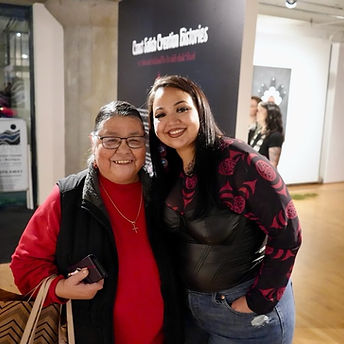
Judy Lynn Gobin is a Tulalip tribal member, Mother, Grandmother and Great Grandmother. She is a Coast Salish basket weaver, a seamstress and loves to bead and make jewelry. Judy was taught by Lummi Master weaver Anna Jefferson, in 1992 through the Northwest Indian College. Judy participated in the Santa Fe Indian Market and earned first place in Textile, Basketry in 2010 with Cedarbark Doll Sets. Awarded Grants through the Potlatch Fund on two occasions to enhance Art, and hold classes on the reservation.

Free Borsey
Lummi Nation
Tsx'vilum Free Borsey is a Lummi Nation artist, muralist, and environmental steward whose work lives at the intersection of land, culture, and community. Based in Bellingham, he creates large-scale public art rooted in Coast Salish tradition, making Indigenous stories visible at the scale they deserve. His practice spans murals, cultural education, and youth leadership.

Epiphany Couch
spuyaləpabš (Puyallup), Yakama, and Scandinavian/Mixed European
Epiphany Couch is an interdisciplinary artist working across photography, beadwork, weaving, and collage, she reinterprets traditional forms to create images, installations, and sculptural works that engage ancestral knowledge and invite new ways of understanding.
Her practice is rooted in unconventional collaboration—across time, between generations, and with the natural world—recognizing these relationships as vital to sustaining memory, culture, and identity. Her work has been acquired for public and private collections and exhibited in museums, galleries, and art fairs across the United States. Couch lives and works in Portland, Oregon, where she is a member of the artist-run gallery Carnation Contemporary, the Columbia Basin Basketry Guild, and the Cyme Collective.

Daniel Baptista
Puyallup
Daniel Baptista creates art that honors Coast Salish culture and the Lushootseed language. His work blends traditional symbols with modern design and has been featured in projects such as the Tacoma Light Trail, the Twulshootseed Yard Sign Project, and a commemorative sign recognizing the sx̌ʷəbabš (Swift Water People) as the original inhabitants of Vashon and Maury Islands, as well as in community murals, tribal early learning center, language revitalization efforts, cultural events, and educational programs that celebrate and promote Coast Salish heritage and Indigenous identity. Through his art, he helps keep Indigenous stories and language alive for future generations.

Amber Stephens
Puyallup
Amber Stephens’ work follows a journey of reconnection with her tribe’s histories, language, and traditions alongside self-reflections on lessons she’s learned on the way. Through her art she weaves together storytelling and community, honoring cultural preservation while exploring new ways for traditions to grow and evolve. Amber works with digital and traditional art mediums to bring together teachings from old and new. Her background as a game level designer informs her thoughts on space, interaction, and storytelling, often including viewers in the experience of her work. Whether creating small works or large public installations, Amber’s goal is to create art that feels welcoming. She hopes to encourage the viewer’s curiosity and grow a deeper appreciation for the living traditions of Coast Salish art and culture.

Chris Duenas
Puyallup
Chris has worked for the Puyallup Tribe in Language Program since 2011 and Heritage Division since 2023. Chris had been developing his style of contemporary coast salish art since 2012. Chris incorporates his experience with the Lushootseed language, native culture, Puyallup history, Coast Salish songs and traditional narratives in his artwork. Chris works primarily with digital art, however several pieces have been translated to many different mediums. He continues to expand his skillset and test new mediums as a way to share our native culture and history.

To create Lushootseed Creation Histories, artists and curators Matika Wilbur (Swinomish & Tulalip) and Amber Hayward (Puyallup) convened Lushootseed language departments, language holders, and Tribal artists. Through shared gatherings grounded in listening — to the land, the language, and the teachings — artists created works that do not illustrate these histories, but embody them. Across carving, weaving, painting, installation, and language work, these teachings are held in material form, making visible what has always been present.
This exhibition invites visitors to reconsider dominant timelines and confront the white-washed narratives that have long obscured Indigenous presence. Everywhere we stand in North America is Indigenous land, and every place carries its own creation story. To learn the origin stories of the land we inhabit is to step into a deeper understanding of stewardship, sovereignty, and belonging.
Lushootseed Creation Histories affirms that ancestral knowledge is not static. It evolves, breathes, and continues to guide Coast Salish communities today. By centering language and story, this exhibition honors the enduring cultural and political sovereignty of Coast Salish peoples and offers an opportunity for all who enter to listen, learn, and witness.